
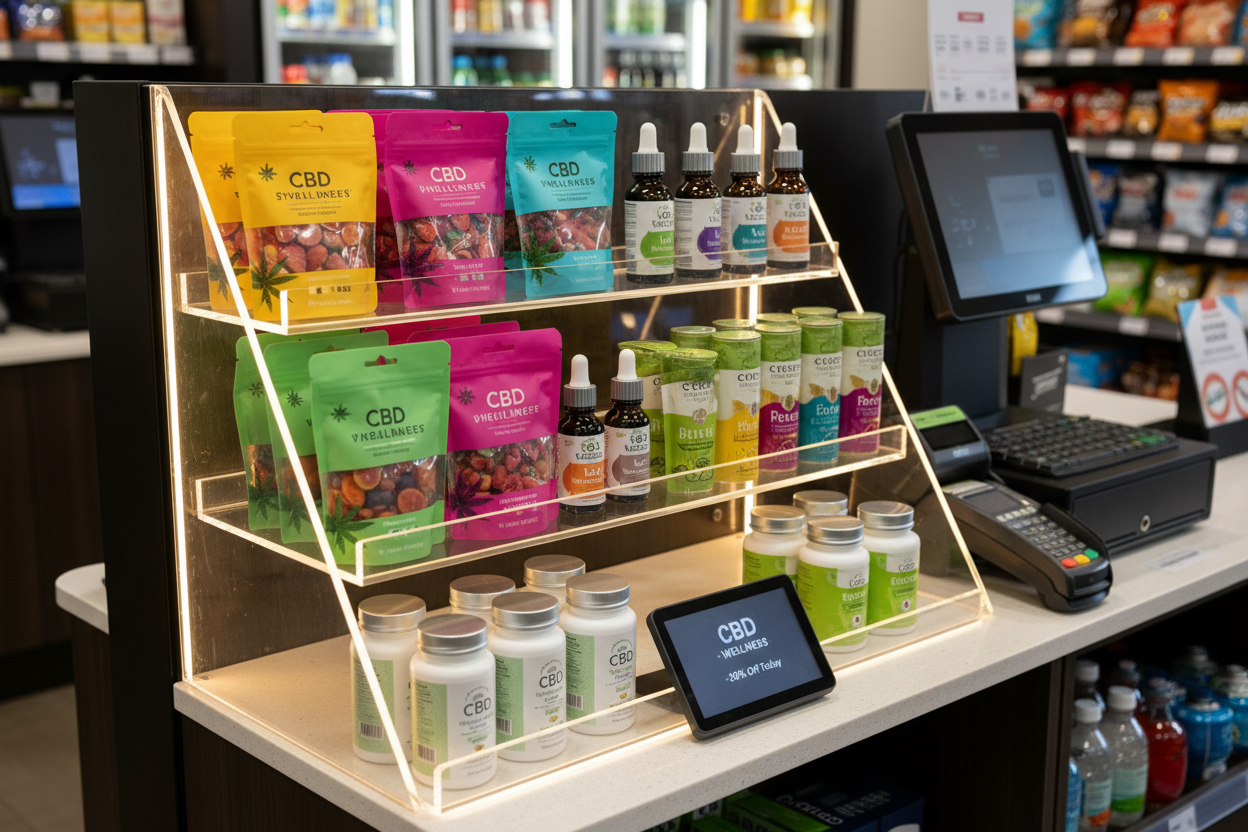
If you've spent any time near a gas station counter, a smoke shop, or even a grocery store checkout line lately, you've probably seen it: brightly colored packaging promising a "legal high" from something called Delta-8 THC. It's become one of the fastest-growing categories in the hemp industry — and one of the most misunderstood.
At Nuvita, we get asked about Delta-8 fairly often, usually some version of the same question: "Is this the same thing you use in your gummies?"
The short answer is NO. Here's the longer answer.
What Is Delta-8 THC?
Delta-8 THC (short for delta-8-tetrahydrocannabinol) is a cannabinoid found in the cannabis plant, but only in trace amounts — typically less than 1% in raw hemp. That's far too little to extract directly at any commercial scale.
So how does a whole industry exist around it?
Nearly all the Delta-8 THC on the market today isn't extracted from the plant at all. It's manufactured. CBD, which hemp produces abundantly, is converted into Delta-8 THC through a chemical process that typically uses solvents, acids, and catalysts. What comes out the other end is a psychoactive compound similar in structure to Delta-9 THC (the primary intoxicating compound in marijuana), just slightly less potent milligram-for-milligram.
Because it's derived from hemp rather than marijuana, Delta-8 has existed in a legal gray zone since the 2018 Farm Bill legalized hemp and its derivatives, provided the finished product stays under certain THC thresholds. Manufacturers have leaned on that loophole to sell an intoxicating product with far less oversight than a state-licensed cannabis dispensary would face.
Why Delta-8 Raises Red Flags
A few things about Delta-8 give us pause, and they're worth understanding regardless of which brand you buy from.
It's a synthetic conversion, not a natural extract. The chemical reactions used to convert CBD into Delta-8 can leave behind unwanted byproducts and reaction residues if not carefully controlled and purified. Testing across the industry has found inconsistent results from batch to batch, and in an unregulated market, "carefully controlled" isn't guaranteed.
Regulation and testing vary wildly. Because Delta-8 exists outside the traditional cannabis regulatory framework, there's no consistent national standard for how it's made, tested, or labeled. The FDA has issued public warnings about adverse event reports tied to Delta-8 products, ranging from vomiting and hallucinations to loss of consciousness, and has flagged concerns about products marketed with packaging that could appeal to children.
Federal hemp law is tightening around exactly this issue. New federal hemp legislation targets the kind of synthetically derived, intoxicating cannabinoids that built the Delta-8 market. The direction of travel is clear: the loophole that let Delta-8 flourish is closing.
It's intoxicating, and that's not what we're building. Delta-8 produces a psychoactive high, similar to marijuana, just something way cringier. That may be exactly what some consumers are looking for. It is not, however, aligned with what Nuvita is trying to deliver.
Why Nuvita Doesn't Use It
Nuvita was built on a simple premise: wellness products should do what they say, be made the way they say, and hold up to real scrutiny. That's the whole reason we're USDA Organic certified and FDA-registered in the first place, standards that most Delta-8 products on the market don't come close to meeting.
A few specific reasons Delta-8 doesn't fit into our lineup:
- We formulate for function, not intoxication. Our gummies and supplements are built around specific outcomes, like calm, sleep, or balance, using cannabinoid and ingredient profiles that support those goals without getting you high. Delta-8 works against that goal by design.
- We don't rely on synthetic conversion processes. Our manufacturing is in-house, which means we control our inputs and processes from raw material to finished product. We're not interested in outsourcing quality control to a chemical conversion process we can't fully verify.
- We test everything, independently. Every Nuvita product is verified through third-party lab testing so you know exactly what's in it, and what isn't. That level of transparency is hard to find in the Delta-8 market, where testing is often inconsistent or absent entirely.
- We're building for the long term. Federal hemp policy is actively evolving, and products built around regulatory loopholes are the ones most exposed when those loopholes close. We'd rather build a lineup that doesn't need one.
What We Use Instead
Where Delta-8 tries to mimic a marijuana high through synthetic conversion, Nuvita's products are formulated with well-studied, naturally occurring cannabinoids like CBD, CBG, and CBN, chosen and dosed for specific wellness goals rather than intoxication. That's a fundamentally different mission, and it's one we're not willing to compromise for a trend.
If you've been curious about Delta-8 because you're looking for stress relief, better sleep, or a way to unwind, there's a good chance one of our formulations, like Chill or Dream, can get you there without the tradeoffs.
This post is for educational purposes only and is not intended to diagnose, treat, cure, or prevent any disease. These statements have not been evaluated by the Food and Drug Administration.



Leave a comment
This site is protected by hCaptcha and the hCaptcha Privacy Policy and Terms of Service apply.